
🏢 The "Missing" Square Footage: Understanding Floor Area Harmonisation
If you’ve been browsing new launch brochures lately, you might have noticed something strange: the units look the same, but the numbers on paper feel slightly "smaller." No, developers haven't suddenly shrunk the bedrooms—it’s all thanks to Floor Area Harmonisation.
Here is a quick breakdown of what this means for your next property move and why those percentages matter.
What is Harmonisation?
In the past, different government agencies (URA, SLA, BCA, and LTA) had different ways of measuring "floor area." It was a bit of a headache for everyone involved.
The Change: As of June 2023, all agencies moved to a unified definition.
The Goal: What you see is what you get. The Strata Area (what you pay for) must now align with the Gross Floor Area (GFA) (what the developer is allowed to build).
The Result: "Free" bonus spaces that developers used to include in your purchase price—like air-con ledges—are now mostly excluded from the sellable area.
What is the typical % difference?
Before this rule, there was a gap between the space the developer was allowed to build and the space they were allowed to sell to you.
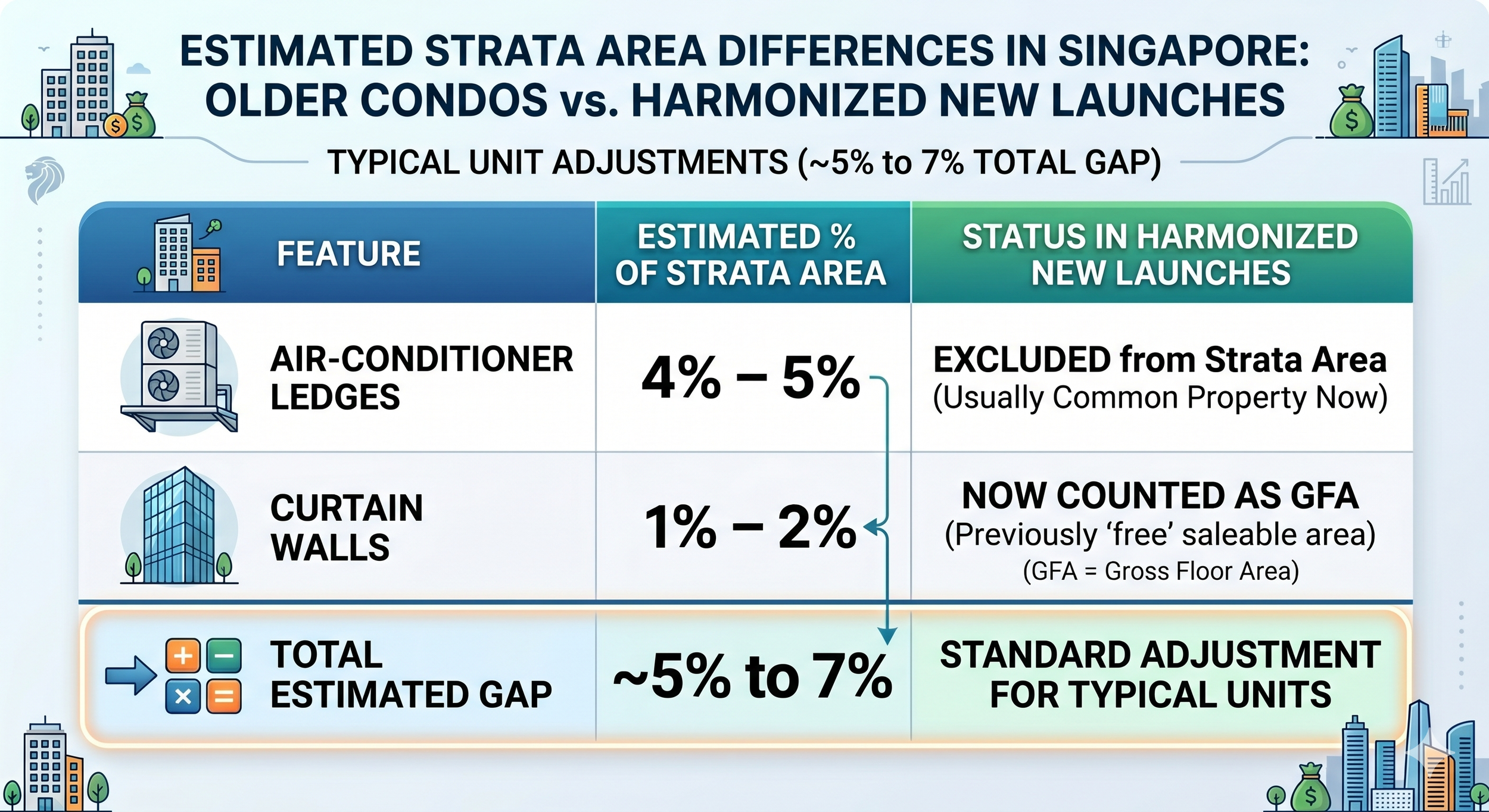
The Gap: Typically, there was a 5% to 7% difference between the old measurement system and the new harmonised one.
The "Shrinkage": Because developers can no longer charge you for certain technical spaces, a unit that would have been 1,000 sq ft under the old rules might now be marketed as roughly 950 to 970 sq ft.
The Reality Check: The usable living space (your living room, bedrooms, etc.) remains identical. You’re just no longer paying for the "invisible" bits.
All about Harmonisation
Where is that % derived from?
That 5% to 7% difference didn't just vanish into thin air. It was primarily derived from three specific areas:
Air-con (AC) Ledges: This is the biggest culprit. Previously, AC ledges were included in your strata area (you paid for them), but they didn't count towards the developer’s GFA. Now, they are excluded from both.
Curtain Walls: In the past, the entire thickness of a glass curtain wall could be included in the strata area. Now, only the "inner" part counts.
Void Spaces: High ceilings or "void" areas over living rooms are now more strictly regulated to ensure buyers aren't overpaying for empty air.
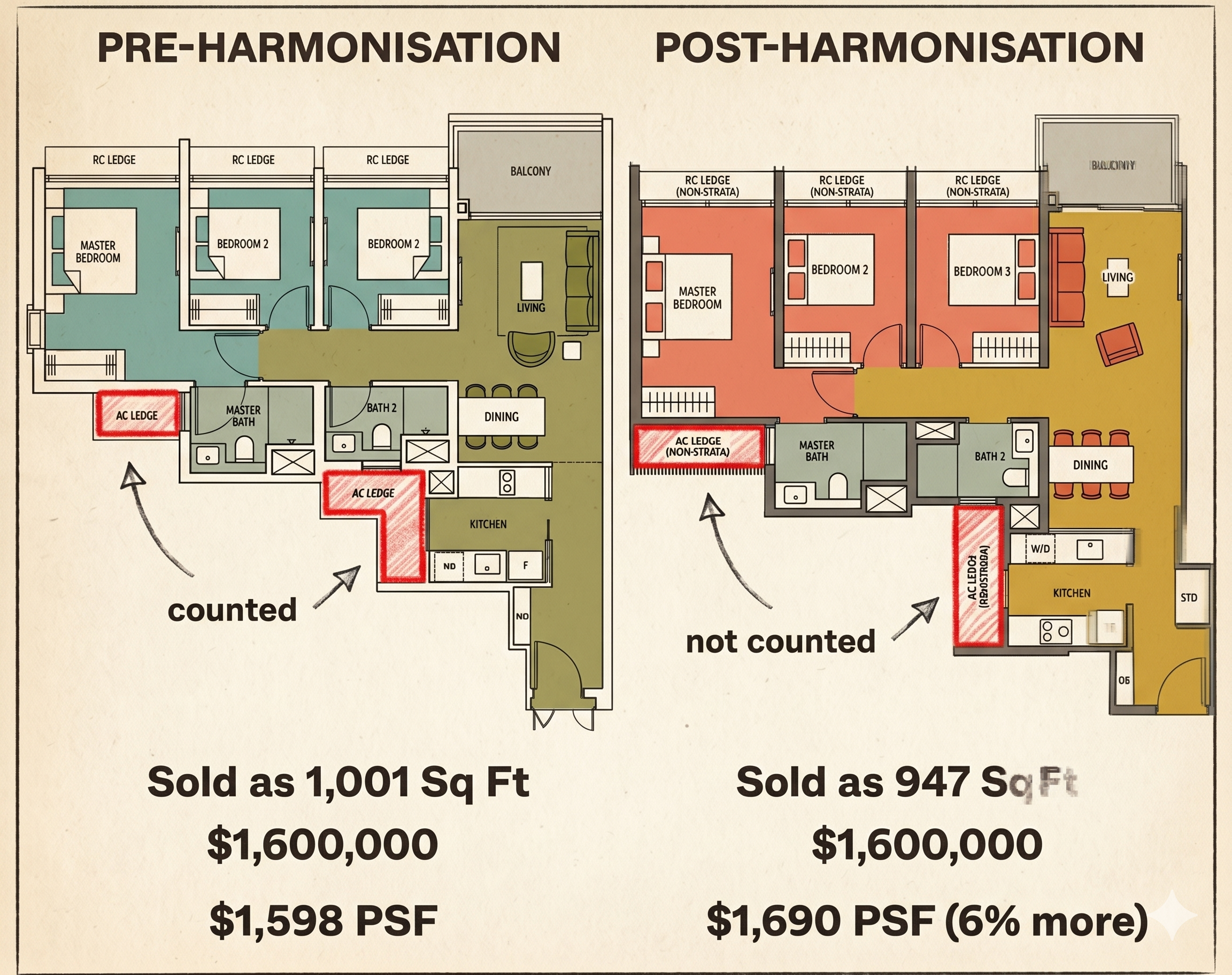
Why does this matter to you?
While the units might look smaller on paper, this is actually a win for transparency. You now have a much clearer idea of the efficiency of a layout. When you compare two projects, you’re comparing actual living space rather than who has the largest air-con ledge!
Confused by the fine print?
Real estate in Singapore is about more than just buying and selling—it’s about navigating complex regulations, legacy planning, and data-driven asset progression.
If you want to look beyond the brochures and understand how market analytics impact your wealth preservation, it’s time for a deeper conversation.
Connect with Edmund Lim
Expertise in Asset Progression, Portfolio Restructuring, and Market Analytics.