
⚡ ROI vs ROE: The Critical Metric Singapore Property Investors Overlook
When evaluating Singapore residential property, many potential buyers walk away after doing a simple rental yield calculation.
A common reaction goes something like this:
"A $2 million condo fetches $5,500 to $6,000 monthly rent. That is only around 3.3% to 3.6% gross yield. After paying condo maintenance, property tax, and interest, why lock up funds when safe instruments or overseas markets offer higher advertised yields?"
This conclusion overlooks an important distinction: confusing Return on Investment (ROI) with Return on Equity (ROE).
1. What Is the Difference?
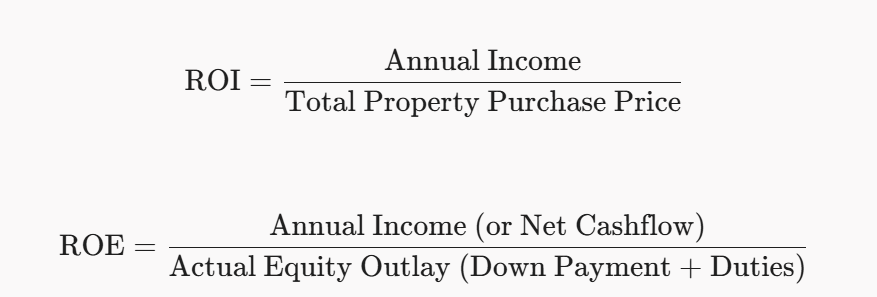
Return on Investment (ROI): Measures your annual earnings against the total valuation of the property, regardless of how much came from your pocket versus bank financing.
Return on Equity (ROE): Measures your earnings against the actual cash and CPF equity you personally committed.
Physical real estate provides access to long-tenure, low-cost institutional leverage—using Other People’s Money (OPM) under Monetary Authority of Singapore (MAS) framework guidelines.
2. A Singapore Case Study: The 75% LTV Scenario
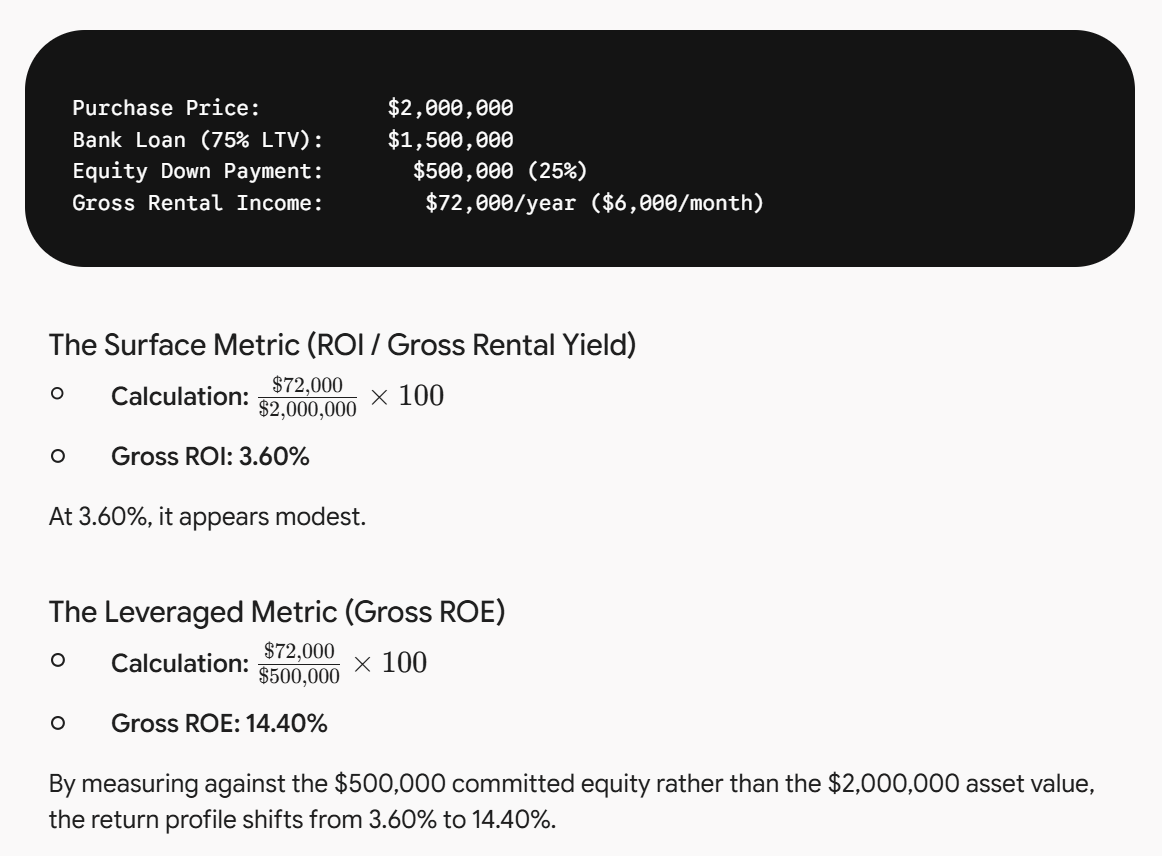
Under current MAS Loan-to-Value (LTV) limits for a first residential housing loan, the maximum bank financing is 75%, requiring a 25% equity down payment (minimum 5% cash, up to 20% CPF Ordinary Account/cash).
Consider an investor purchasing a $2,000,000 private condominium rented out at $6,000 per month ($72,000/year).
3. Factoring in Holding Costs & Mortgage Interest
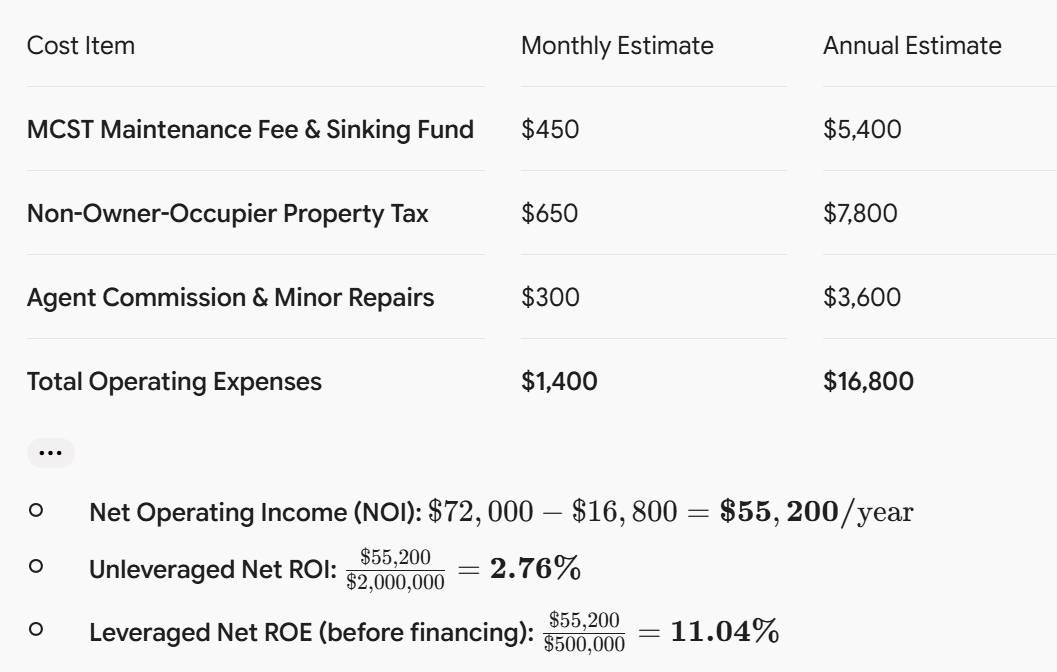
Net returns account for typical holding expenses and financing costs for a $2M private condo in Singapore:
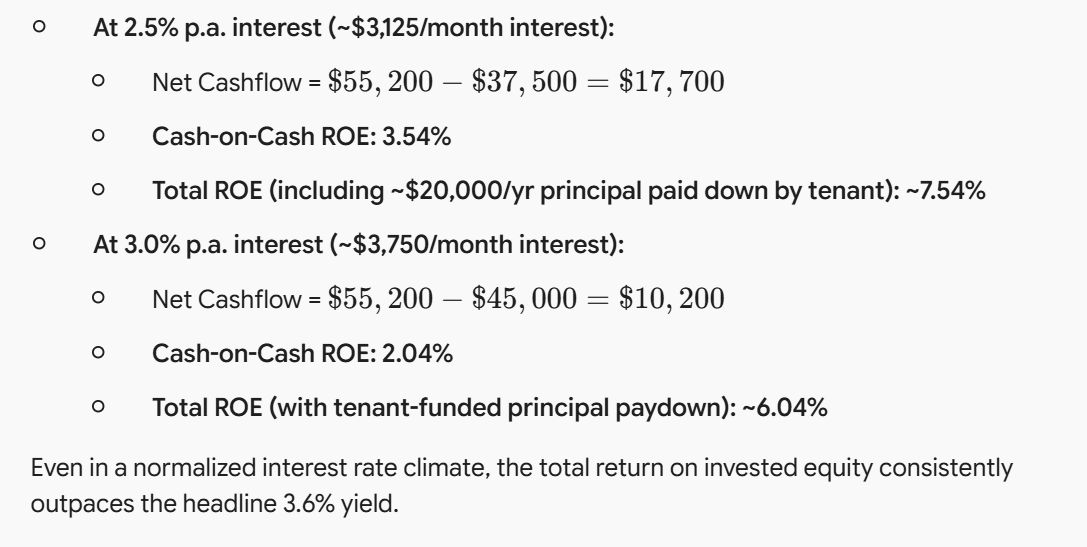
Adding Mortgage Interest Under Singapore Conditions
4. Why ROE Changes Over Time: The "Lazy Equity" Trap
ROE is not static—it evolves as a property matures:
Equity Accumulates: With every monthly installment, the principal drops while capital appreciation raises property value.
Denominator Expands: A $500,000 starting equity can grow to $900,000 over 7–10 years through principal paydown and price gains.
Return Compresses: If rental income remains constant while equity doubles, your effective ROE drops.
When equity sits idle without compounding, it becomes "lazy equity." At this stage, portfolio restructuring, equity cash-out refinancing, or capital redeployment helps maintain an efficient ROE.
Well, here is my Investor Calculator which you can give it a try to understand your Property “Efficiency”
Strategic Property Portfolio Planning
Leverage requires prudent execution. Maximizing ROE involves navigating regulatory and financing constraints in Singapore:
TDSR (Total Debt Servicing Ratio): Capped at 55%, determining actual borrowing capacity.
ABSD (Additional Buyer's Stamp Duty): Proper holding structures (such as decoupling, single-name structuring, or trust planning) help avoid punitive tax drag on subsequent purchases.
Cash Buffers: Maintaining 6 to 12 months of mortgage obligations ensures resilience through tenant turnover or economic shifts.
🚀 Beyond Just Buying & Selling Homes...
Real estate in Singapore is rarely just about browsing listings on property portals. Are you facing complex situations such as:
🔄 Asset Restructuring & Portfolio Optimization (Transitioning from 1 to 2 properties safely)
⚖️ Decoupling, Part-Share Purchases & Matrimonial Property Planning
📜 Legacy Planning, Trust Structures & Inter-Generational Wealth Transfer
🏢 Commercial & Industrial Real Estate Acquisitions (Exempt from ABSD)
💼 CPF Accrued Interest & Retirement Housing Roadmaps
Don’t leave Singapore’s largest financial decisions to guesswork or standard formulas.
Ready to map out your property blueprint?
📲 Contact me today for an in-depth, non-obligatory consultation and take control of your property future!
.