
🚀 Understanding Lease Decay in Singapore Property: Why the "Bala’s Curve" Matters for Your Exit Strategy
If you own or are looking to buy a leasehold property in Singapore, you’ve likely heard people throw around terms like "Lease Decay" and "Bala’s Curve."
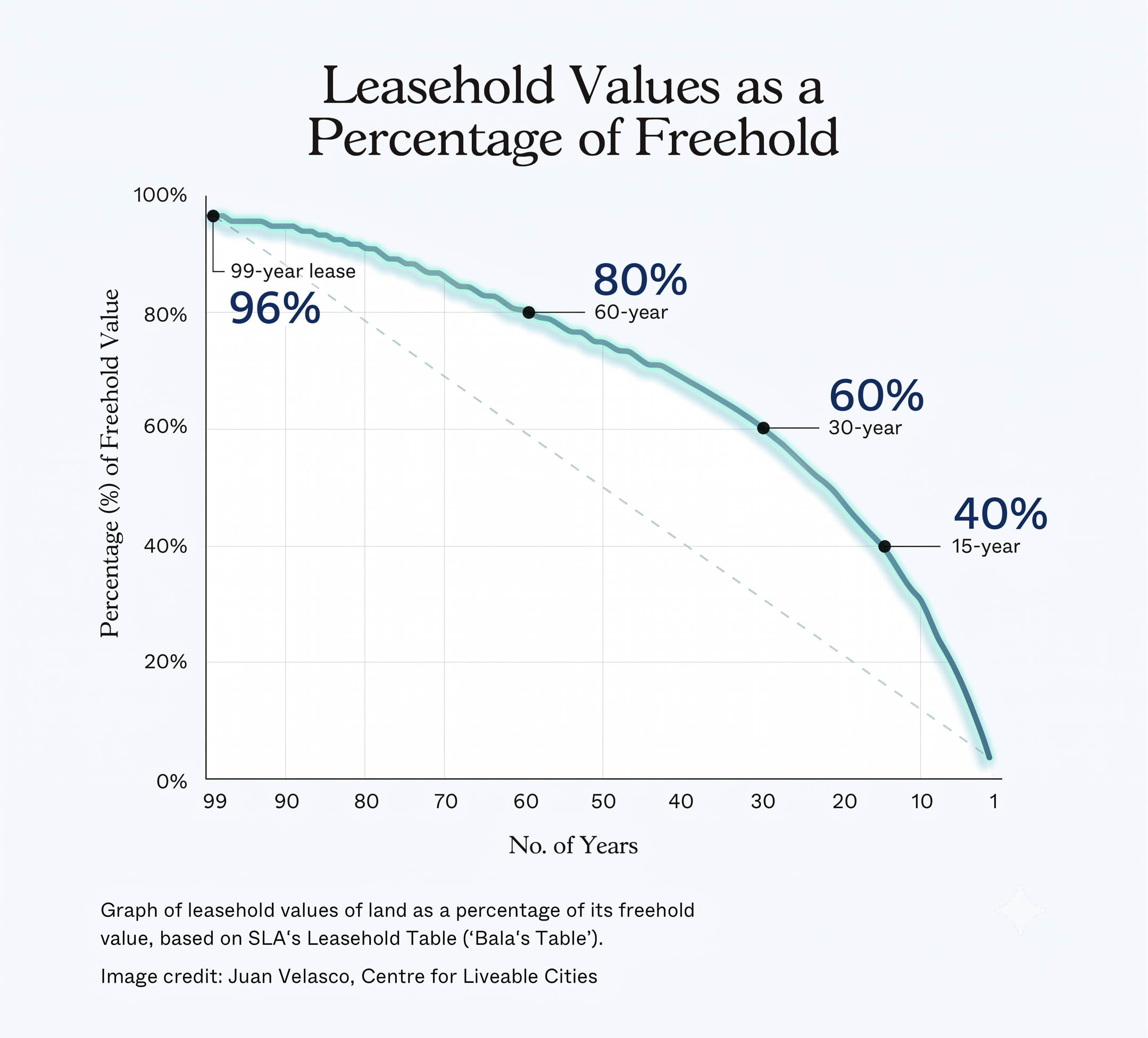
Many buyers assume that a 99-year leasehold property loses value evenly at 1% every year. The reality? Property value depreciation is not a straight line.
Understanding how a leasehold property actually loses value over time can mean the difference between a high-yield exit strategy and being stuck with an unsellable asset. Let’s break down the mechanics of lease decay in simple, easy-to-digest terms.
📉 What is Bala’s Curve?
Bala’s Curve (officially adopted by the Singapore Land Authority) is a discounted cash flow table that plots the legal value of a leasehold property as a percentage of an equivalent freehold property.
Here is a quick snapshot of how a 99-year leasehold property retains value against a freehold equivalent according to the table:
99 Years Left: Retains ~96% of Freehold Value.
75 Years Left: Retains ~89% of Freehold Value.
60 Years Left: Retains ~80% of Freehold Value.
40 Years Left: Retains ~64% of Freehold Value.
30 Years Left: Retains ~50% of Freehold Value.
0 Years: Retains 0% (Reverts to the State).
🔑 Key Takeaways from the Curve
1. The "Honeymoon" Phase (0–20 Years)
During the initial 20 years of a fresh lease, depreciation is very gentle (roughly 0.2% per year on a Bala basis).
Why prices still go up: Market inflation, urban development, and rising land costs often outweigh the minor lease decay, making fresh 99-year leasehold properties appreciate quickly in their early years.
2. The 60-Year Turning Point
Once a property hits the 60-year mark, the curve starts to steepen noticeably.
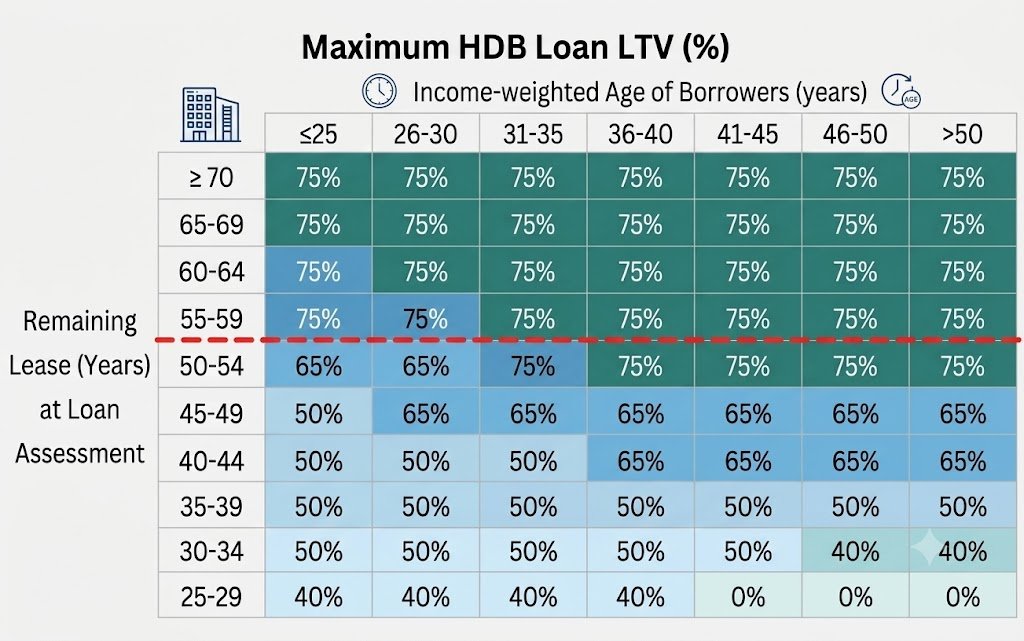
This is the stage where buyer pools begin to shrink due to financing limits, CPF restrictions, and banks shortening loan tenures.
3. The Steep Cliff (Below 40 Years)
When a lease drops below 40 years, value erosion accelerates sharply.
Below 20 years remaining, CPF funds cannot be used at all, and getting a bank loan becomes nearly impossible—severely crippling demand.
⚠️ How Financing Restrictions Speed Up Real-World Decay
Bala’s Curve represents the theoretical value, but actual resale prices are heavily governed by government policies and banking rules:
CPF Usage Cap: If the remaining lease does not cover the youngest buyer up to age 95, the amount of CPF OA funds allowed for the purchase is pro-rated.
Bank Loan Limits: Financial institutions cut down maximum loan tenures as the lease drops, forcing future buyers to put up significantly larger cash downpayments.
Reduced Buyer Pool: Because young buyers face CPF/loan limits on old properties, your potential buyer pool naturally shrinks down to older cash-rich buyers or short-term investors.
💡 How to Strategic Plan Around Lease Decay
"Should I avoid older leasehold properties completely?"
Not necessarily. Older properties often offer larger square footage, mature locations, and attractive rental yields. However, they require a clear, disciplined strategy:
Plan your exit early: If you own an aging leasehold property, evaluate your position around the 60 to 65-year mark before the steep decay kicks in.
Evaluate property purpose: Are you buying to live for the rest of your life, or are you buying for wealth growth and restructuring?
Compare alternatives: Measure the price-gap between older leasehold properties, newer leasehold units, and freehold options to see where the real value lies.
📲 Thinking Beyond New Launches and Resale Purchases?
Real estate in Singapore isn't just about picking between a brand-new launch unit or a standard resale property—it’s about managing long-term capital risk and crafting an asset-progression roadmap that aligns with your life stage.
Whether you need help with:
Restructuring an aging property portfolio before lease decay impacts your net worth.
Decoupling strategies or multi-property financial planning.
En-bloc asset viability checks and land-value analyses.
Calculating CPF accrued interest vs. property appreciation returns.
Get in touch with me today for a personalized, data-backed consultation.

.